What’s Coming Up in the Woods
The majority of ephemerals in this photo essay were found in Skiles Test Nature Park in spring 2025. See if you can spot these native wildflowers this spring in the park.
Bloodroot
While its name evokes red, the bloodroot produces large white blossoms with yellow centers that emerge in a stunning fashion on single stems directly from the ground. The six to 12 petaled flowers are among the first woodland wildflowers to bloom in the spring. The plant’s name comes from the red sap the leaves, stems and roots release when broken. You will often find colonies of bloodroot growing in moist, shady areas. This photo was taken in mid-March in the southwest section of the park.
Cut-leaf Toothwort
This early spring ephemeral produces clusters of small four-petaled white to light pink flowers that droop from a stem with deeply split leaves with tooth-shaped edges. The plant’s long, slender stems can grow to be 8 to 15 inches tall. A beautiful member of the mustard family, the cut-leaf toothwort will form colonies and can be found growing on forest floors and woodland slopes. The cut-leaf toothwort in this picture was found in early April along Trail 4 as it heads west to Johnson Road.
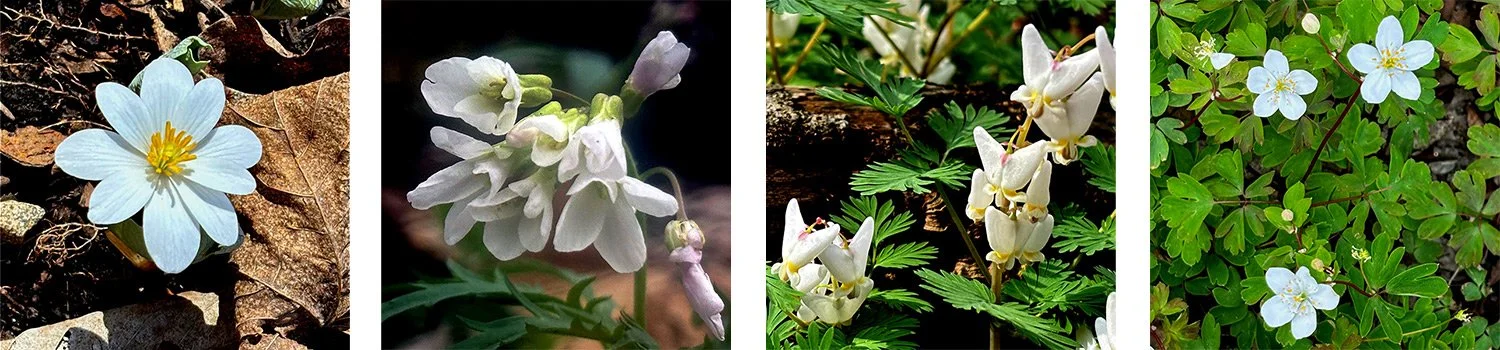
Ephemerals commonly seen in Skiles Test Nature Park (from left): bloodroot, cut-leaf toothwort, Dutchman’s breeches, false rue anemone.
Dutchman’s Breeches
This aptly named plant produces flowers that look like white pantaloons drying upside down on a clothesline. A yellow lobe resembling a waist band and the single stalk from which four to 14 blooms hang completes the look. These upside-down flowers are fun and functional, as they help protect the flower’s pollen from wind and rain but make it difficult for most insect species to pollinate. For that, the plant’s reproductive fate primarily relies on long-tongued queen bumblebees that can reach the nectar deep inside and pollinate the flower.
Luckily, for the Dutchman, bumblebees are one of the first pollinators to emerge in the spring. The flowers in this photo were found in mid-April along the western edge of Trail 4.
False Rue Anemone
The False Rue Anemone blooms in massive clusters that blanket the ground from early to mid-spring. The plant produces cheerful five-petaled white flowers with a center of delicate white stalks topped with bright yellow, pollen-bearing tips. These cup-shaped flowers are likely to be found at the base of wooded slopes or bottomlands above bright green, deeply cut foliage. This photo was taken in early April in the woods along Trail 5.
Harbinger-of-Spring
The harbinger-of-spring is one of the most difficult wildflowers to spot. Each flower is miniscule, consisting of five white petals, each of which is a mere 1/8 of an inch long. These teeny-weeny beauties are one of the earliest native wildflowers to bloom in moist woodlands but often come and go largely undetected with flowers that rarely poke their heads more than 1 inch above the deep leaf litter. The harbinger-of-spring in the photo was discovered in early March 2026 along Trail 3.
Spring Beauty
These early spring flowers grow low to the ground and are usually found in large patches. The spring beauty produces tiny, delicate flowers that range in color from white to light pink or pink-striped. The five-petaled flowers close at night and on cloudy days and open on sunny days. Look for the spring beauty in shady areas along the Skiles Test Trail and Trail 4 as it runs west toward Johnson Road. This photo was taken in early April.
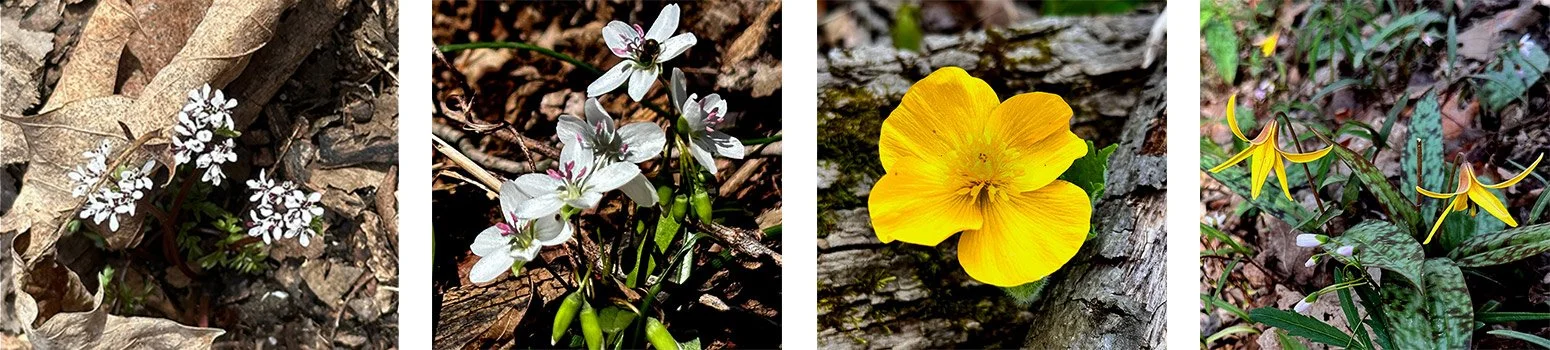
Ephemerals commonly seen in Skiles Test Nature Park (from left): harbinger-of-spring, spring beauty, wood poppy, yellow trout lily.
Wood Poppy
The wood poppy produces small clusters of bright yellow to yellow-orange flowers that create a striking contrast against the forest understory. The four-petaled blossoms grow atop tall stems with deeply sectioned blue-green foliage. The stems contain a bright yellow to orange sap that was used by Native Americans as a dye. You will find wood poppies from April to June along streams and ravines in open woodlands. The wood poppy pictured here was growing along western edge of Trail 4 in late April.
Yellow Trout Lily
The yellow trout lily can be identified by its nodding lily-like flower and the purple splotches on its leaves that resemble the speckled scales of a brook trout. Flowers are not easy for this plant to produce. It takes four to five years for the plant to store up enough energy in its roots to produce a flower. Once the plant flowers, the striking yellow and bronze trumpet bloom lasts for only a few days. Trout lilies form large colonies that are often found near streams in moist soils.