

Migratory Birds: Nature’s Super Athletes
When it comes to migration, birds reign supreme. They travel farther, faster and in greater numbers than any other animals, all the while exhibiting remarkable feats that showcase their unparalleled athletic abilities.
Some birds rack up more than 44,000 miles a year to bask in an endless summer. One little Arctic Tern set a record with a whopping 59,650 miles during its yearly migration. When it comes to pure endurance, the undisputed champion is a female Bar-tailed Godwit that flew an astonishing
7,500 miles over the open Pacific Ocean from Alaska to New Zealand without a single stop for food, water or rest. The entire journey took this little shorebird nine days of continuous flying to complete.
As a class, birds take to the skies during migratory periods in numbers that are hard to fathom. On one peak night in September 2025, a record breaking 1.2 billion birds were documented moving southward over North America in a sweeping wave while most of us slept. Exactly how these pint-sized super athletes undertake one of nature’s most extraordinary feats of endurance and navigation captivates scientists and bird enthusiasts alike. These little guys not only need to get the timing right but also must possess the physical strength to withstand intense exertion, lack of food, storms and strong headwinds, plus the navigational acuity to remain on course, steer clear of predators and avoid hitting structures.
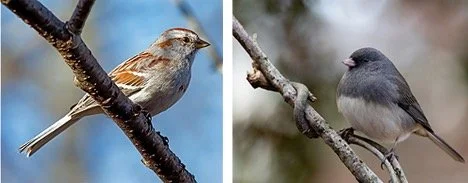
American Tree Sparrow (left) and Dark-Eyed Junco (right) migrate from Canada and spend winters here.
Physical Adaptations Power Flight
Behind these epic journeys lies a dramatic transformation process that turns birds into aerodynamic fuel-efficient flying machines. The process begins weeks before migration with a serious desire to chow down and build up fat reserves. Fat is fuel of choice for long-distance flyers because it supplies more than twice the energy of carbohydrates. Lucky for birds, a biological adaptation converts high-energy foods like berries and fruit that are rich in carbs into stored fat that fuels long flights.
Some species nearly double their body weight before they depart, adding mass and bulking up the size of the muscles that power wing movements. The enlarged muscles help with the delivery of oxygen as do changes to the cardiovascular and respiratory system.
Prior to migration, a bird’s heart can increase in size by 15% to 25%, enhancing its ability to pump oxygen-rich blood to working muscles. Likewise, the respiratory system undergoes structural adaptations that include air sacs extending into hollow bones. These changes increase lung capacity and efficiency and allow migrating birds to maintain flight at high altitudes where oxygen levels are significantly lower.
In the weeks preceding migration, many bird species even exhibit behaviors akin to a pre-flight training program. During this period, birds have been observed undertaking longer and more frequent high-intensity flights. Researchers believe this increased flight activity helps prepare the cardiovascular system and flight muscles for the extreme challenges ahead.
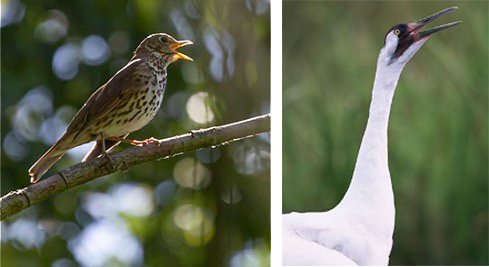
The Wood Thrush (left) thrives in wooded areas and is known for its flute-like song. Whooping cranes (right) may be seen at the Goose Pond Fish & Wildlife Area during migration season.
Habitat-Rich Stopovers are Critical
All in all, migration is no roost in the park. Birds must carry enough fat to power long haul flights but remain light enough to minimize the energy used. To get the most out of their tanks, these migrants rely on another amazing transformation. Once birds reach their stopover site, their digestive system, which shrinks during flight to reduce weight, rapidly expands, and the strong desire to stuff their beaks returns. On some level, birds understand their plight and seek out stopovers with abundant food stores, instinctively knowing that habitat-rich areas are essential for their survival.
Refueling isn’t the only concern for these weary travelers. In a weakened state, migrating birds are especially vulnerable to predators and seek out habitats that offer both food and cover. Areas rich in vegetation, like shrublands, forests and wetlands, allow hungry birds to forage while providing protection from predators. When these critical habitats are lost to development, agriculture or climate change, migratory birds face an increased risk of starvation and predation. According to the U.S. Fish and Wildlife Service, the loss, degradation and fragmentation of critical habitat is potentially the largest individual threat to migratory birds.
In northeast Indy, Skiles Test Nature Park is part of a natural landscape corridor that stretches from Geist Reservoir through Fort Harrison and along the Fall Creek Greenway. This wildlife area is augmented by the Mud Creek Valley watershed and acres of wooded and well-vegetated land that borders the corridor. With more than 2,000 acres of protected habitat, the Fall Creek corridor provides a vital resting stop for migratory birds.
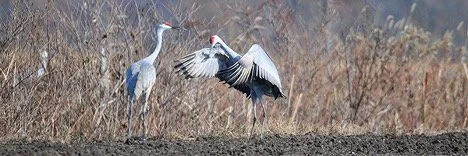
Each fall, thousands of Sandhill Cranes visit Jasper-Pulaski Fish & Wildlife Area.
Top Bird Watching Spots
With remnants of tall grass prairies, vast hardwood forests and the sand dunes along Lake Michigan, Indiana serves as a critical stopover for hundreds of bird species. Last year, more than 526 million birds crossed the state from Aug. 1 to Nov. 15. In all, more than 420 species have been documented in the state, including rare birds and species that strayed from their established ranges.
Most of Indiana’s diverse birdlife migrate along the Mississippi flyway, an air path that aligns with the shorelines of Lake Michigan channeling birds to the southern tip of the Lake where they rest and refuel along the Indiana Dunes National Lakeshore. Some birds will end up wintering in the state while others use Indiana’s wide-ranging habitats as temporary stopovers on their cross-country flights.
September through early November is prime time for birders to spot nonresident birds as they travel through the state.
