

Attracting Bluebirds to the Park
Spring is house hunting season for eastern bluebirds, and Skiles Test Nature Park has three fully renovated, move-in ready nesting boxes to offer the perfect couple. The houses were built by Kevin Senninger, president of BRAG and bluebird enthusiast, several years ago. At the end of each mating season, he removes the boxes for cleaning and maintenance and reinstalls them in the spring.
When it comes to nesting, bluebirds prefer small holes in standing dead or dying trees (snags) but aren’t physically equipped to create such a cavity. Instead, they rely on the craftsmanship of hardheaded woodpeckers. Woodpeckers are highly skilled at excavating holes in snags. The dwellings they build and usually abandon after one nesting season generate a valuable housing stock for bluebirds and over 85 species of wildlife living in North American forests. Without woodpeckers, many animals would be left homeless.
The demand for these hollow nesting chambers coupled with the commonplace removal of dead trees for safety, aesthetic and development reasons has created a supply crunch. For eastern bluebirds, the market outlook is especially dire as they also face fierce competition from aggressive house sparrows and European starlings. These non-native birds will destroy eggs and kill nestlings and their parents while taking over a bluebird nesting site.
In the late 1960s, eastern bluebird populations reached a record low with an almost 90% decline in their numbers. To help bluebirds rebound, nest boxes were developed and designed to keep starlings out while providing a cavity-like environment for the birds to raise their young. As a result, eastern bluebird numbers have steadily increased and now stand at an estimated 23 million in North America.
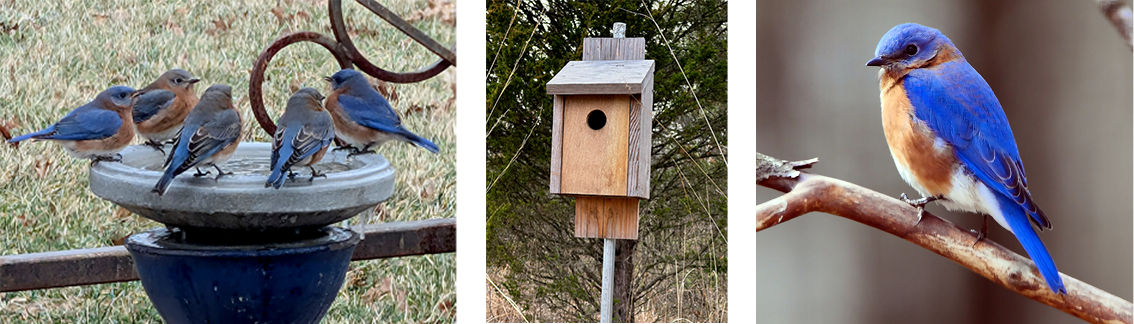
Above, from left: Bluebirds in the backyard (photo courtesy of Kevin Senninger); bluebird nesting box at Skiles Test Nature Park; bluebird in the wild.
Nest Boxes
Nest boxes come in a variety of styles, but not all fit the needs of eastern bluebirds. Before you purchase or build a nesting box, check out the North American Bluebird Society recommendations. These guidelines cover important details, such as entry hole size, ventilation and drainage, predator protection, construction materials and interior size. These specifications must be met to produce the best outcomes for the nesting cycle. NABS also provides a variety of detailed plans for builders as well as how to monitor the nest box and control predators. By providing a quality nest box, you are helping bluebirds produce offspring that will successfully mature and fledge.
Location, Location, Location!
Once the nest box is in hand, you will need to decide where to place it. Bluebirds prefer open spaces with scattered trees, sparse ground cover and lots of insects. Yum! Parks, pastures, fields, backyards and other expanses of short grass are potentially good habitats for nestboxes. However, it’s best to avoid areas where pesticides and herbicides are used. These products are harmful to birds and decrease and sometime eliminate the insect population.
Position the birdhouse facing east or northeast. This provides birds with protection from the wind and direct sun. To keep it safe from predators like cats and raccoons, mount the house on a pole or post between 4 and 6 feet above the ground. Metal poles with a slick surface have a slight safety advantage as they can be harder for some animals to climb.
Give the couple some privacy. Place the box at least 50 to 100 feet away from heavily trafficked areas or other birdhouses and throw in a couple of nearby trees, fence posts and other perching spots from which a bluebird could drop to the ground and grab some grub.
Provide shallow water for bathing. Bluebirds prefer water that is less than 2 inches deep with perches nearby. Flat rocks can be added to vary water depths and provide secure footing.
The Perfect Home
When selecting the ideal home, bluebird pairs use a divide and conquer approach. The male scouts the area and selects a location with potential nesting sites. He then lays claim to it by singing to attract the missus and to warn others to stay away. Once the female arrives, the male shows off the sites by fluttering his wings and carrying nesting material in and out of the cavity. Since the female does most of the nest building, she inspects the sites by popping in and out before selecting one.
Female bluebirds build cup-shaped nests from dry grass, small twigs and pine needles. Feathers, animal hair and other soft materials may be added for comfort. She can lay two to seven pale blue eggs in a single nesting attempt. Each attempt constitutes a brood, and she can have one to three broods in a single season.
Beginning the day the last egg is laid, an 11- to 19-day incubation periods begins before the tiny birds hatch and both parents shift into high gear, delivering a steady stream of protein-packed caterpillars, beetles, grasshoppers, crickets and other insects to the rapidly growing nestlings. In 17 to 21 days, the nestlings will be fully feathered and attempting to fly. In most ranges, eastern bluebird nesting season runs from mid-March to early August.
If you spot bluebirds in the park, email us at stnp@binford71.org and let us know. We are hoping to attract the birds and would be delighted to know if they are in the area.
