

Restoring the Health of the Forest
Asian bush honeysuckle is one of the most harmful invasive plants in Indiana. The plants are so damaging to natural areas that the state designated four species of bush honeysuckle as invasive pests and made it illegal to sell, grow for sale, gift, exchange, distribute, transport or introduce these plants in the state of Indiana. Managing the spread of Amur, Tartarian, Morrow’s and Belle’s honeysuckle is a major focus of restoration work that occurs annually at Skiles Test Nature Park.
In May 2025, the Office of Land Stewardship, which manages the park’s natural areas, contracted with the ecological restoration professionals at Eco Logic to clear the dense thickets of honeysuckle growing in the northwest corner of the park.
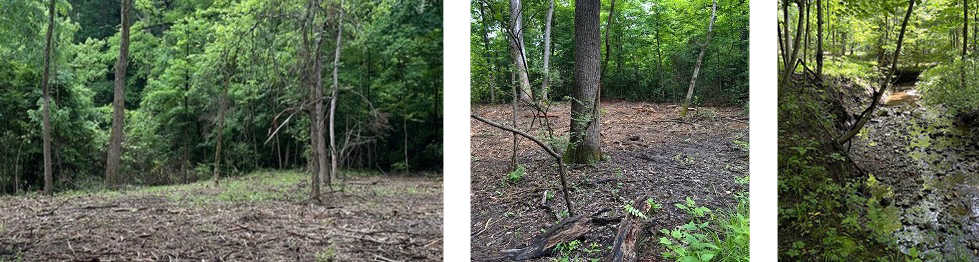
At left, woodland areas that were overrun with honeysuckle are now free of the invasive shrub. Center: these trees were enveloped by bush honeysuckle but now have the space and resources to grow. Right: this creek and woodland area is now open to park visitors after the dense honeysuckle was removed.
The forest understory in this area was completely covered with bush honeysuckle, which threatened the development of the young tulip, sugar maple and black locust trees growing there.The primary problem with Asian bush honeysuckle is that it grows so densely that it crowds out native plant species on the forest floor, thereby greatly reducing the food and cover available for wildlife and essentially preventing the regeneration of young trees. The shrub’s compacted canopy also decreases the volume of rainwater that reaches the forest floor. Some varieties can poison the soil by releasing chemicals that inhibit plant growth. In a hardwood forest, a serious honeysuckle infestation can reduce tree stem growth by 58% and decrease tree growth rate by 50%.
In the northwest corner of the park, the bush honeysuckle was so large and established that a tractor with a forest mulcher was used to remove it. But even that may not prevent the plant from resprouting. Restoration professionals will need to return later in the year to spray any new growth with an herbicide.
Controlling the establishment and spread of Asian bush honeysuckle is a constant battle for land stewards and conservationists because dense thickets of these woody shrubs are prevalent throughout the urban landscape.
The plants thrive along roadsides and other neglected areas. Full sun to forest shade, they’re not picky. Bogs, lakeshores and riparian areas are also home to bush honeysuckles.
Few benefits from invasive honeysuckle
Asian bush honeysuckles are prolific fruit producers. Birds and other wildlife that feed on the bright red and orange berries distribute seeds into surrounding areas but in turn receive little nutritional benefit. The berries are more like junk food, high in carbs but low in protein and fat that migratory songbirds depend on for long flights. Deer won’t eat Asian bush honeysuckle. A forest full of the stuff significantly reduces the woody browse available for deer in the winter.
Many native bee species also turn up their noses when it comes to bush honeysuckle blossoms, preferring specific native plants instead. Other generalist insect species, like the European honeybee, aren’t so picky and are drawn to the blossoms and sweet scent of bush honeysuckle.
When it comes to picking a site for a nest, birds are drawn to Asian bush honeysuckle because it leafs out earlier than native shrubs. Despite its attractiveness, the structure of the bush provides less shelter and more visibility to predators. As a result, birds produce up to 20% fewer offsprings when their nests are placed in bush honeysuckle rather than a thicket of native plants with thorns. Humans can suffer as well from the prevalence of bush honeysuckle.
Thick concentrations of Asian bush honeysuckle have been linked to escalations in tick populations and tick-borne illnesses. White-tailed deer use honeysuckle-rich areas for cover. As a result, ticks that feed on deer flourish there, too.
Given the numerous detrimental effects associated with infestations of Asian bush honeysuckle, we are grateful for the restoration work the park is receiving and look forward to seeing native ephemerals return to the northwest forest floor next spring and the growth of a stronger, more resilient woodland.
